
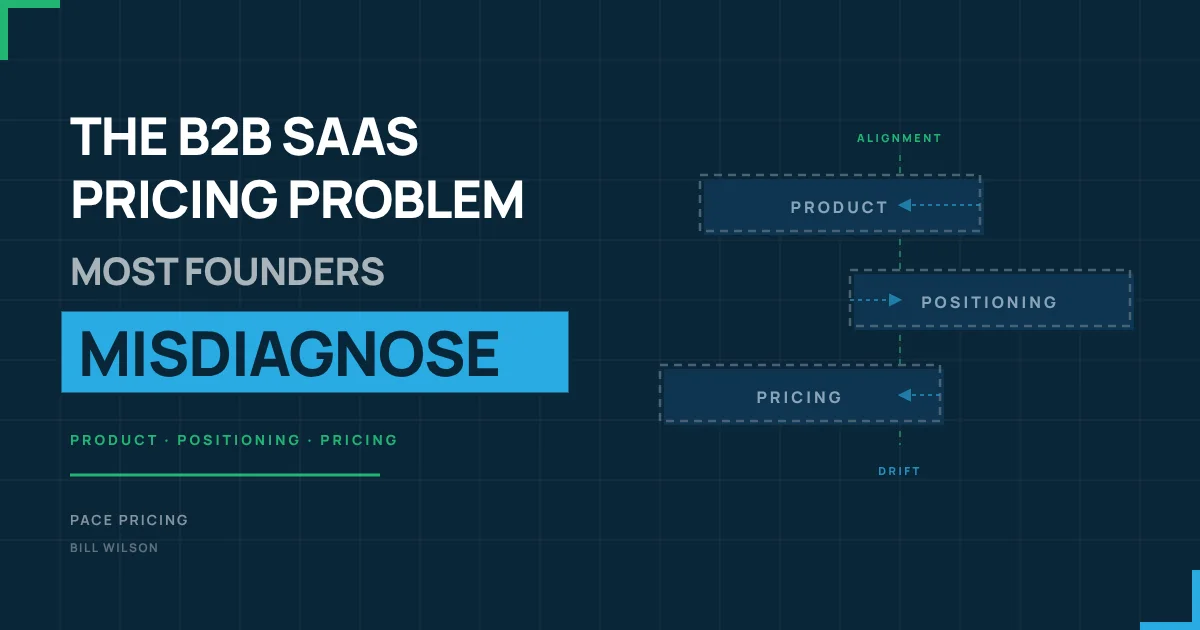
I've had some version of this conversation 400 times. A founder comes in convinced the price is wrong. We dig in. What we find instead is a product built for one customer, positioned for another, and priced like it's a third thing entirely.
I used to be surprised by this. I'm not anymore.
Product, positioning, and pricing aren't three separate workstreams. They're one system. Change one and you shift the others whether you meant to or not. Most SaaS companies manage them in separate quarters with separate teams. Sometimes separate consultants. The system breaks at the handoffs, and nobody sees it because each team thinks their part is fine.
What "alignment" means
Product is the value you create. Not the feature list. The progress your customer is trying to make and the job they're hiring you to do. Positioning is the story you tell about that value: who it's for, why you, what the buyer needs to understand before they ever see a price. Packaging makes that story concrete. Pricing is how you capture the value, the mechanism and the number that represents a fair exchange for the progress you've created.
Those four things need to point at the same job. When they do, selling gets easier in ways that are hard to attribute: deals move faster, discounting drops, expansion starts happening before you ask for it. When they're off, you get a kind of friction that's hard to locate. Stalled deals. Buyers who seemed interested and then went quiet. A sales team working hard but unable to close at the price you want.
The most common pattern I see
Products grow. Stories don't keep up.
A team ships a feature. Then another. Pretty soon there are twenty things on the pricing pagePricing PageA pricing page is the web page where a SaaS company presents its plans, prices, and packaging to prospective buyers. It's typically one of the highest-traffic and highest-conversion-impact pages on a SaaS website.Read more → and the buyer is trying to figure out what they're actually getting. The package becomes a buffet. Every customer sees something they don't want, and the whole thing starts feeling less valuable, not more.
This is the dilution effect, and it's not a theory. It's a documented cognitive bias. Nisbett, Zukier, and Lemley named it in 19811: when people are presented with a mix of relevant and irrelevant information, they don't filter the irrelevant stuff out. They average it in. The relevant signal gets weaker. Applied to your pricing page, this means every feature a buyer doesn't need dilutes the perceived value of the ones they do. They start asking themselves, "why am I paying for things I don't use?" and willingness to payWillingness-to-PayWillingness-to-pay (WTP) is the maximum amount a customer would pay for a product or feature. In B2B SaaS, WTP research helps set price points that capture value without exceeding what customers find acceptable.Read more → drops. More features, added with good intentions, producing less perceived value. I've seen it enough times that a sprawling pricing page is now one of the first things I flag as a positioning problem.
One company I worked with had five acquired products: different pricing models, different brand names, different value metricsValue MetricA value metric is the unit of measurement that determines how a customer is charged. It's the axis along which price scales — such as users, contacts, API calls, revenue managed, or storage.Read more →, all being sold together. One of their leaders described the sales motion as "selling the kitchen sink and the neighbor's dog." Revenue had stalled. The products were good. Buyers just couldn't reconstruct the story from what was in front of them.
The fix was a positioning reset — one narrative connecting all five products to a single customer outcome, then simplified bundling and metrics to match. The price barely changed.
Why pricing research won't save you
When pricing feels broken, the reflex is to run pricing research, model price points, test tiers. That work is worth doing, but if the product and positioning aren't clear first, better data just tells you more precisely how confused your buyers are. It doesn't fix the confusion.
McKinsey's research2 on this is worth reading. Companies with best-in-class pricing and packaging practices see roughly 16 percentage points higher NRRNet Revenue RetentionNet revenue retention (NRR) measures the percentage of recurring revenue retained from existing customers over a period, including expansion, contraction, and churn. An NRR above 100% means existing customers are spending more over time.Read more → than peers. The phrase in their research is "pricing and packaging practices," not price points. The gap comes from building a system where customers can see the value, not from landing on the right number.
High Alpha's 2025 research3 found that public software companies with NRR above 120% command a 63% premium in valuation multiples, and every 1% improvement in retention adds 12% to company value over five years. That gap doesn't close by running a pricing experiment. It closes by making the value obvious enough that expansion is a natural next step, one the customer initiates rather than one your team has to push.
What it looks like when the system works
A healthcare SaaS company I worked with had acquired several products over the years. Multiple products, multiple buyers inside the same account, no shared narrative. The pricing page had just accumulated over time, new tiers bolted on as new products came in, nothing retired.
Customer interviews surfaced the job clearly: customers wanted to measure, improve, and demonstrate that the care they were delivering was getting better over time. That outcome had never been named anywhere in their marketing, even though every product they had was built to deliver it. Buyers were having to connect the dots themselves, and most weren't.
We named the job. Built a narrative around it. Restructured the packaging so buyers could see a logical path through the product suite, and simplified the value metrics to two numbers a buyer could put in a budget conversation. Once the story was clear, the pricing conversation got short. Adding a second product to an existing account started producing ARPA increases of more than 2x. Same products, new story.
Three questions worth asking your team
I use these as a quick diagnostic before any deeper engagement.
What job is the customer hiring you to do? Ask this to five different people at your company. If you get five different answers, pricing is the least of your problems. You have a positioning problem that will make every other thing harder.
Does your packaging show that job clearly? A buyer who lands on your pricing page should be able to figure out what they're getting without reverse-engineering your roadmap. If the page requires work to decode, the packaging is hiding the value.
Is your price built around the outcome or the cost? Cost-plus and competitive benchmarking are both anchored to the wrong thing. The number should scale with the progress you create for the customer, not what it costs to build or what a competitor charges.
If those three answers aren't pointing at the same thing, that's the problem. Usually that simple. Usually that hard to see from inside.
The gap between median and elite B2B SaaS companies (90%+ GRR and 120%+ NRR at the top end) rarely comes down to features. It comes down to whether the value story is clear enough that buyers know what they're getting and can see why more of it makes sense.
Key takeaways
Product, positioning, and pricing are one system. Manage them separately and you'll create friction you can't locate.
Value dilution (adding features without sharpening the core story) is the most common problem I see, and the most overlooked.
Better pricing data doesn't fix a positioning problem. Sequence: product clarity, then positioning, then pricing.
120% NRR is downstream of alignment. Sales execution is downstream of that.
Three questions to start: What job? Does the package show it? Does the price match the outcome?
To close
Most pricing engagements start the same way and end the same way. Founder thinks the price is wrong. We dig in. The price is a symptom.
What I keep finding is that the hard work has usually been done. There's real value in the product. But the story was never made clear enough for buyers to see it. Name the job, build packaging that walks buyers through the progress they're trying to make, and the pricing conversation gets short fast. Founders are usually a little surprised by that. They expected more math.
Start with the job your customer is trying to do. Everything downstream of that, packaging, metrics, price points, gets easier once the job is named. That sequencing — research, then narrative, then packaging, then price — is the spine of the PACE System.
Sources
1. Nisbett, R. E., Zukier, H., & Lemley, R. E. (1981). The dilution effect: Nondiagnostic information weakens the implications of diagnostic information. Cognitive Psychology, 13(2), 248–277.
2. McKinsey & Company. The net revenue retention advantage: Driving success in B2B tech.
3. High Alpha (2025). Net Revenue Retention 2025: Why It's Crucial for SaaS Growth.
Frequently Asked Questions
+What does "product, positioning, and pricing alignment" mean in B2B SaaS?
All three telling the same story. Your product delivers a specific outcome. Your positioning names that outcome and says who it's for. Your pricing captures value in proportion to the progress you create. When any one drifts, the whole system creates friction: buyers get confused, deals stall, and discounting becomes the workaround for a story that isn't landing.
+Why do most B2B SaaS pricing problems start with positioning, not the price itself?
Pricing is the last signal in the chain. If a buyer can't see the value clearly, no price feels right. Too high feels arbitrary, and discounting signals that you don't believe the number either. Companies with best-in-class pricing architecture see roughly 16 percentage points higher NRR than peers. That gap comes from making value visible, not from finding the optimal number.
+What is value dilution in SaaS, and why does it hurt pricing?
Every feature you add without sharpening the core story spreads buyer attention thinner. The primary job gets harder to see through the noise. Over-featured products don't command higher prices. They confuse buyers and erode willingness to pay. More features, if the story hasn't kept up, can actually lower what buyers think the product is worth.
+How does Jobs-to-be-Done (JTBD) connect to B2B SaaS pricing strategy?
JTBD gives you the unit of value your pricing should capture. When you understand the specific progress a buyer is trying to make, you can build packages that map to that outcome and price in proportion to it. Pricing anchored to a clear job scales with expansion. Cost-based or benchmark pricing doesn't.
+What's the right sequence for fixing broken SaaS pricing?
Product clarity first, then positioning, then pricing. Running pricing research before those two are solid gives you better data on the wrong question. Once buyers can see the value clearly, the price conversation gets much shorter, faster than most founders expect.
+What's a realistic NRR target for B2B SaaS, and how does pricing affect it?
Elite B2B SaaS companies hit 120%+ NRR. Public software companies at that level command a 63% valuation premium, and every 1% improvement in retention adds roughly 12% to company value over five years. Getting there requires alignment across product, positioning, and packaging. Pricing optimization alone won't move those numbers.
Related Articles
How to Sell a Platform Story Before Your Products Are a Platform
If your company acquired multiple products and the board wants a platform story before integration is done — the narrative already exists in your customers' language. Surface it first.

Understanding Customer Pain: The Secret to B2B SaaS Success
It's easy to focus on the benefits of our products, but, the truth is, customers look for solutions to their problems.

The 'Who' Factor: How to Optimize Your Pricing Page for Maximum Sales
Want to sell more? Your pricing page is the key. Level up by looking at the “Who.”